Client went bankrupt with your invoice unpaid: filing a claim and reclaiming the VAT (Netherlands)
16 November 2026 · 6 min read · checked and edited by Jarno van den Hove
If a client goes bankrupt while your invoice is still open, you can no longer make them pay or take them to court yourself. You file your claim with the trustee (curator), with the invoice and your agreements as evidence. As an ordinary (unsecured) creditor you will, according to the KVK, probably get nothing or only part of it. What you do get back is the VAT you already paid: you deduct it in your VAT return as soon as it is certain you will not be paid (in full), and at the latest 1 year after the due date. (General information, not tax or legal advice.)
Is your client really bankrupt?
A declared bankruptcy (faillissement) appears in the Central Insolvency Register of the Dutch judiciary (insolventies.rechtspraak.nl) and in the KVK Business Register. That is also where you find the name of the trustee. An out-of-court arrangement or a WHOA composition does not appear there; you only hear about those from your client or their adviser. A client who says they are “almost bankrupt” is not bankrupt in law: you can still send reminders or agree a payment plan.
Filing your claim with the trustee
During a bankruptcy you can only pursue your client through the trustee (Articles 26 and 110 of the Dutch Bankruptcy Act, Faillissementswet). This is how you file:
- Send the trustee a written statement of what your client owes you: the invoice amount including VAT, with invoice number, date and due date
- Attach the evidence: the invoice and, where you have them, the order confirmation or quote and your reminders
- Ask for a receipt; you are entitled to one (Article 110(2))
- Interest that runs after the date of the bankruptcy does not count (Article 128)
- If you have trade credit insurance, report the bankruptcy to your insurer straight away
Deadlines: when must your claim be in?
The trustee tells known creditors in writing by when they can file (Article 109). If there is a verification meeting (verificatievergadering), your claim must reach the trustee at least two weeks before it; a claim filed later is no longer verified. If there is so little money that ordinary creditors will get nothing anyway, the supervisory judge can decide that no verification meeting is held (simplified settlement). So file as soon as you can, even if you expect little: then you are on the list if there turns out to be something to share.
What will you get back?
The trustee sells what there is and shares out the proceeds in a fixed order. First come the costs of the bankruptcy itself, such as the trustee's fee. Then the creditors with priority, the preferential creditors, such as the Belastingdienst and the UWV. Whatever is left goes to the unsecured creditors, and as a freelancer with an ordinary invoice you are usually one of them. According to the KVK you will then probably get nothing or only part. If there is nothing at all, the bankruptcy is closed for lack of assets.
Still working for this client?
An ongoing assignment does not end by itself. You can give the trustee a reasonable period in writing to say whether they want to continue it (Article 37). If you keep working, agree with the trustee in advance that your new invoices will be paid from the estate, and invoice as soon as possible. If you delivered goods under retention of title that are still with your client, ask for them back through the trustee. If you yourself still owe the bankrupt client money from before the bankruptcy, you may, under conditions, set it off against your claim (Article 53).
Reclaiming the VAT
If you use the invoice basis (factuurstelsel), you already paid the VAT in the quarter of the invoice. If your client does not pay, you get it back. You do not apply for it separately; you process it in your normal VAT return:
- When: in the return for the period in which it is certain the invoice will (partly) not be paid, and at the latest in the period in which 1 year has passed since the agreed final payment date
- If no payment term was agreed, the statutory term of 30 days after receipt of the invoice counts as the final payment date
- How: you deduct both the turnover and the VAT of the unpaid invoice in box 1a (21%) or 1b (9%)
- If you use the cash basis (kasstelsel), you never paid the VAT, so there is nothing to reclaim
- If the trustee pays out something later, you declare the VAT on that part again in the period in which you receive the money
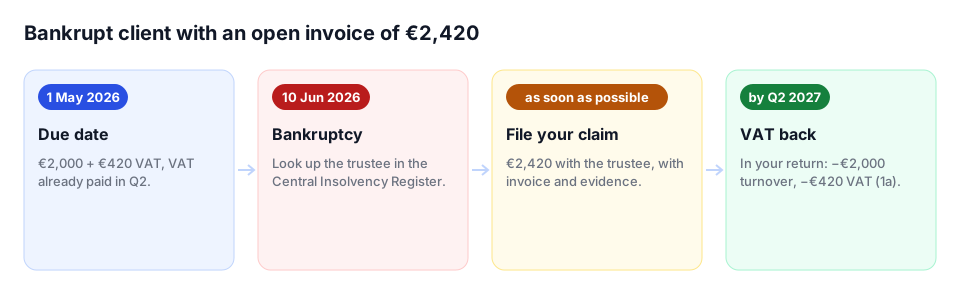
Worked example: an invoice of €2,420
On 1 April 2026 you send an invoice of €2,000 + €420 VAT = €2,420, due by 1 May 2026. You pay the €420 VAT in your return for the second quarter of 2026. On 10 June 2026 your client is declared bankrupt. You file €2,420 with the trustee. Once it is certain you will get nothing, for example because the bankruptcy is closed for lack of assets, you enter −€2,000 turnover and −€420 VAT in box 1a of your next return. If it stays unclear, you do so at the latest in the return for the second quarter of 2027, because the year after the due date ends on 1 May 2027. If the trustee later pays out 5%, €121, that includes 21/121 × €121 = €21 VAT. You declare that €21 again in the quarter in which the money comes in.
Do not issue a credit note
A bankrupt client is no reason for a credit note. Your claim still exists and you file it with the trustee; a credit note would say your client no longer owes you anything. The VAT correction runs through your return, not through a new document. You only issue a credit note when the invoice itself was wrong.
A bankrupt client in Factando
Factando has no separate “uncollectable” status. Leave the invoice open and switch off the automatic reminders for that invoice, so no emails go to a bankrupt company. Do not void the invoice: it would then drop out of your VAT overview for the original quarter, even though you did pay that VAT there. Factando does not add the correction of −€2,000 and −€420 to the VAT overview automatically; you enter it yourself in your return, or pass it on to your accountant. If the trustee pays something out, you record that yourself: Factando does not handle part payments.
Sources
The rules in this article come from these official pages. Check the current amounts and deadlines there.
Frequently asked questions
How do I file a claim with the trustee?
Send the trustee a written statement of the amount your client owes you, with the invoice and other evidence. The trustee's name is in the Central Insolvency Register.
Will I get my money back if my client is bankrupt?
Often not, or only part of it. The costs of the bankruptcy and the preferential creditors, such as the Belastingdienst, are paid first. What is left goes to ordinary creditors like you.
Can I reclaim the VAT if my client is bankrupt?
Yes, on the invoice basis. You deduct the turnover and VAT of the unpaid invoice in your VAT return as soon as it is certain you will not be paid, and at the latest in the period in which 1 year has passed since the final payment date.
Should I send a credit note to a bankrupt client?
No. Your claim still exists and you file it with the trustee. You correct the VAT in your VAT return, without a credit note.
Done with invoicing by hand?
Factando makes a correct Dutch invoice for you: numbering, VAT and layout are handled automatically. Try it free without an account; saving and sending takes a free account (3 sent invoices a month). Pro, with automatic payment reminders, is free for 14 days.