Payment reminder email templates for freelancers in the Netherlands
9 November 2026 · 7 min read · checked and edited by Jarno van den Hove
An unpaid invoice is rarely a refusal to pay. Most of the time it is a forgotten email, a missing purchase order number or an accountant on holiday. A reminder that is polite, specific and sent on time gets most invoices paid without any conflict. Below are three templates you can copy: a friendly first reminder, a firmer second reminder, and a final notice. After the templates come the Dutch rules you need to know before you mention interest or collection costs, because they differ for business clients and consumers. (General information, not legal advice.)
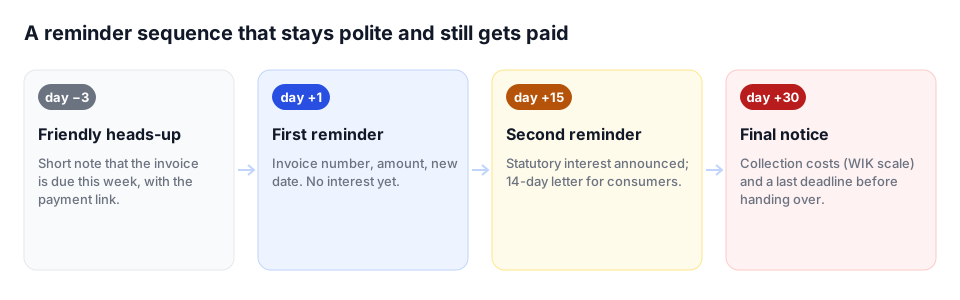
What do you check before sending a reminder?
Business.gov.nl's step-by-step plan for unpaid invoices starts with a phone call, not a letter: ask whether the work was satisfactory and the invoice correct, and make a note of what was said. Many late payments turn out to be a wrong email address or a disputed line. Only then send the reminder, a few days after the payment term has expired. Always mention the invoice number, the invoice date, the amount and the original due date, and attach the invoice again so nobody has to search for it.
Template 1: friendly first reminder (a few days after the due date)
Subject: Reminder: invoice 2026-017 (due 3 December)
- Hi [first name],
- A quick reminder that invoice 2026-017 of 3 November 2026 for €4,114.00 was due on 3 December and has not yet been paid, as far as I can see.
- Could you check whether it has been processed? I have attached the invoice again. Payment can go to [IBAN], quoting the invoice number.
- If it has already been paid in the last few days, please ignore this message.
- Thanks, [your name]
Keep this one short and free of any mention of costs. It is a service to a client who most likely forgot.
Template 2: second reminder, business client (about two weeks after the due date)
Subject: Second reminder: invoice 2026-017, €4,114.00 overdue
- Dear [name],
- On [date] I sent you a reminder for invoice 2026-017 of 3 November 2026 (€4,114.00, due 3 December 2026). The invoice is still unpaid.
- Please pay the outstanding amount within 7 days, by [date], to [IBAN].
- I would like to point out that, under Dutch law, statutory commercial interest is due from the day after the due date (Article 6:119a Dutch Civil Code) and that I am entitled to €40 compensation for collection costs (Article 6:96 Dutch Civil Code). I would rather not charge these, so I hope we can settle this quickly.
- If there is a problem with the invoice or the work, let me know and we will sort it out.
- Kind regards, [your name]
Template 3: final notice (14-day letter for consumers)
Subject: Final notice: invoice 2026-017, payment within 14 days
- Dear [name],
- Despite my reminders of [date] and [date], invoice 2026-017 of 3 November 2026 for €414.00 is still unpaid.
- You have 14 days, counting from the day after you receive this letter, to pay €414.00 to [IBAN] without additional costs.
- If payment is not received within this period, I will charge collection costs of €62.10 (15% of the principal, with a minimum of €40, under the Dutch decree on extrajudicial collection costs) plus statutory interest, and I may hand the claim to a collection agency, with the associated legal costs for your account.
- Kind regards, [your name]
For a business client the final notice can be shorter and does not need the 14-day period, but it should still state a clear deadline and the costs that follow. Business.gov.nl recommends sending a formal notice by registered post with confirmation of receipt and keeping copies; for consumers, proof of receipt matters because the 14-day period only starts once the letter has been received.
What are the rules for business clients?
If your client is a business, you are not legally obliged to send a reminder at all; the KVK notes it is wise to do so anyway. The payment term is what you agreed, or 30 days if nothing was agreed. From the day after the due date you may charge statutory commercial interest (the rate for commercial transactions, published by De Nederlandsche Bank), and you may charge collection costs.
Business.gov.nl states that collection costs have a minimum of €40 and a maximum of €6,775, and that the percentage decreases as the claim gets larger. For business clients you may agree different terms in your general conditions. You must inform your client that interest is being charged, for example on the invoice or in the reminder, which is why template 2 mentions it.
What is the 14-day letter for consumers?
If your client is a private individual, the law is stricter. Business.gov.nl: you must first send a demand for payment, free of charge, with a payment term of 14 days. The KVK describes the same letter as the 'fourteen-day letter' or 'WIK letter', after the Dutch act on collection costs (Wet incassokosten). Three things have to be right:
- The period is 14 days counting from the day after the consumer receives the letter, not from the day you send it; the KVK suggests writing exactly that in the letter
- The letter must state in advance what the costs will be if payment does not arrive within those 14 days: the collection costs amount, statutory interest and possible legal costs
- During those 14 days you may not charge any costs; only after the period has passed can you claim collection costs and interest
If you are VAT exempt (for example under the KOR), the KVK notes that you add VAT to the collection costs, because you cannot deduct it. If the letter is missing any of these elements, the collection costs are not due and you have to start again, which is why template 3 names the amount explicitly.
How much can you charge in collection costs?
The amount is fixed by the Dutch decree on extrajudicial collection costs (Besluit vergoeding voor buitengerechtelijke incassokosten). The KVK and Business.gov.nl confirm the key points: 15% over the first €2,500 of the claim, a lower percentage above that, a minimum of €40 and a maximum of €6,775. The full scale is 15% over the first €2,500, 10% over the next €2,500, 5% over the next €5,000, 1% over the next €190,000 and 0.5% above that. For an invoice of €414.00 that is €62.10; for an invoice of €4,114.00 it is €375 + €161.40 = €536.40. For consumers this scale is binding; for business clients it is the default unless your general conditions say otherwise.
What timing works best?
- Day 0: the due date passes
- Day 3 to 5: friendly reminder (template 1)
- Day 14: second reminder with a 7-day deadline and the interest/costs notice (template 2)
- Day 21 to 28: final notice; for consumers the 14-day letter (template 3), by email and registered post
- After that: collection agency or bailiff, or a payment arrangement in writing
Business.gov.nl adds two practical steps that freelancers often skip: put any payment arrangement in writing with a clause that it lapses if an instalment is missed, and if the invoice turns out to be uncollectable, reclaim the VAT you already paid on it in your VAT return.
Let the reminders send themselves
Writing these emails by hand on the right day, for every invoice, is the part that slips. With Factando Pro, reminders go out automatically: a heads-up 1, 3 or 7 days before the due date, a reminder the day after the due date and, if you want, a second one 7, 14 or 30 days later, each with the PDF and the invoice link and your own text. The day before each reminder Factando asks you whether the invoice has already been paid, so a client who paid yesterday never gets chased. Marking an invoice as paid stops the sequence. See pricing for what Pro includes, or start with the free invoice generator and add reminders later.
Sources
The rules in this article come from these official pages. Check the current amounts and deadlines there.
Frequently asked questions
When can I charge interest on a late invoice in the Netherlands?
From the day after the due date. For business clients the statutory commercial interest rate applies; for consumers the ordinary statutory interest rate. You must tell the client you are charging it, for example in the reminder.
What is a 14-day letter (14-dagenbrief)?
A mandatory final reminder to a consumer that gives 14 days, counting from the day after receipt, to pay without extra costs, and that states the collection costs and interest that follow if they do not. Without a correct 14-day letter you cannot claim collection costs from a consumer.
How much are collection costs for an unpaid invoice?
15% over the first €2,500 of the claim, with lower percentages above that; minimum €40, maximum €6,775. For business clients you may agree different terms in your general conditions.
Do I have to send a reminder to a business client before charging costs?
Not by law, but it is advisable, and your general conditions may require it. You do have to inform the client that interest and costs are being charged.
Done with invoicing by hand?
Factando makes a correct Dutch invoice for you: numbering, VAT and layout are handled automatically. Try it free without an account; saving and sending takes a free account (3 sent invoices a month). Pro, with automatic payment reminders, is free for 14 days.