How to invoice as a freelancer in the Netherlands: the legal requirements
9 November 2026 · 6 min read · checked and edited by Jarno van den Hove
If you work as a freelancer (zzp'er) in the Netherlands, every invoice you send has to meet the requirements of the Dutch VAT Act (Wet op de omzetbelasting 1968, Article 35a). The list is short and the same for every trade: a few details about you, a few about your client, a description of the work, and the VAT split out per rate. This guide walks through each item, the deadline for sending an invoice, the default payment term, and how long you must keep your invoices. (General information, not tax advice.)
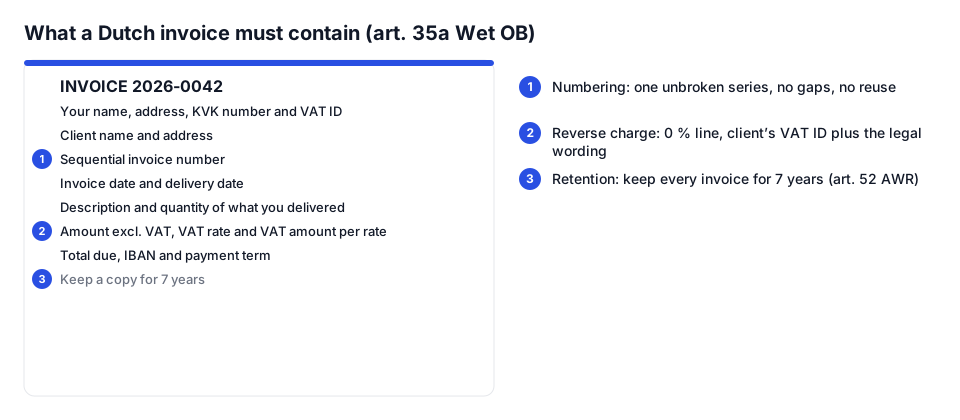
What must be on a Dutch invoice?
The Dutch Tax Administration (Belastingdienst) and Business.gov.nl list the same mandatory items. Your invoice must state:
- Your full name and address, as registered with the KVK (Chamber of Commerce)
- Your VAT identification number (btw-id, format NL000000000B00)
- Your KVK number (Business Register number), if you have one
- Your client's name and address
- An invoice number: the law requires sequential numbering, in one or more series, so that no number is skipped or used twice
- The invoice date
- The date (or period) on which you supplied the goods or services, if it differs from the invoice date
- A description of what you supplied: the quantity and type of goods, or the nature and extent of the services
- Per VAT rate or exemption: the price excluding VAT, any discount not already included in the price, the VAT rate applied, and the VAT amount in euros
Two of these cause most of the questions. First, the number: 1, 2, 3 or 2026-001, 2026-002 are both fine, as long as the sequence is unbroken. If you make a mistake on an invoice, you do not delete it; you issue a credit note and a new invoice, both with their own numbers. Second, the VAT breakdown: if an invoice mixes 21% and 9% items, each rate gets its own subtotal and VAT amount. Showing only a grand total with 'incl. VAT' is not enough.
What changes when your client is in another EU country?
For supplies to a business in another EU country, you must also show your client's VAT identification number on the invoice. If you reverse-charge the VAT, the Belastingdienst requires your own VAT identification number on the invoice as well, and the invoice must make clear that a special VAT arrangement applies. The exact wording and the checks you should do are covered in reverse-charge VAT invoices for EU clients.
When is a simplified invoice (under €100) enough?
Business.gov.nl notes that a simplified invoice is allowed when the invoice total does not exceed €100 including VAT, and for invoices that correct an earlier invoice. A simplified invoice may leave out your client's details. For most freelance work, which is billed in larger amounts to business clients, you will issue full invoices; the simplified version mainly matters for small receipts.
What can you leave off the invoice?
Nothing in the law requires a logo, a payment term, your bank details or the word 'invoice' in a particular language. In practice you add your IBAN and a payment term anyway, because without them your client cannot pay and you have no due date to refer to later. You may write the invoice in English; the Belastingdienst may ask for a translation of specific invoices during an audit, but English invoices to international clients are common and accepted.
When do you have to send the invoice?
Business.gov.nl states that an invoice must be sent no later than the 15th day of the month following the month in which you supplied the goods or service. Work finished on 20 March must therefore be invoiced by 15 April. Many freelancers invoice sooner, at delivery or at the end of each month, because the payment term only starts running once the invoice is out.
What payment term applies if you say nothing?
The payment term is not an invoice requirement, but Dutch law fills the gap if you say nothing. According to Business.gov.nl, if you did not specify a payment term with a business client, the term is 30 days. Business clients may agree a term of up to 60 days in the contract; longer only if it can be shown not to harm either party. Large companies must pay SMEs and self-employed professionals within 30 days regardless of what the contract says, and government bodies must also pay within 30 days.
For consumers there is no legal payment term: you set a reasonable one in your terms and conditions, and 14 days is common. Put the term on the invoice as a date ('due on 9 December 2026'), not just 'within 30 days', so there is no discussion about when the clock started.
A worked example
Say you are a freelance developer in Rotterdam and you worked 40 hours in October 2026 for a Dutch agency at €85 per hour. Your invoice, dated 3 November 2026 with number 2026-017, shows: your name, address, KVK number and VAT id; the agency's name and address; 'Software development, October 2026, 40 hours × €85'; subtotal €3,400.00; VAT 21% €714.00; total €4,114.00. You add your IBAN and 'Payment due by 3 December 2026' (30 days). That single page meets every requirement in the list above.
How long do you keep your invoices?
You must keep your invoices, sent and received, for 7 years. Invoices relating to immovable property must be kept for 10 years. Digital storage is fine; a PDF of each issued invoice plus a list of numbers and totals is enough for an audit, as long as you can produce it within a reasonable time.
Common mistakes
- Restarting the numbering at 1 every month, which creates duplicates across the year
- Leaving out your VAT id because you think it is only needed for foreign clients; it is required on every invoice unless you are exempt under the small business scheme (KOR)
- Writing '21% VAT included' without showing the net amount and the VAT amount separately
- Forgetting the supply date or period when the invoice is sent in a later month
- Changing an invoice after sending it instead of issuing a credit note
The quickest way to get all of this right is to let the layout do it for you. Factando's free invoice generator puts your KVK number, VAT id, the client's details and the VAT breakdown per rate in the right place, and you download the PDF without an account. With a free account you also get sequential numbering across your invoices, and Pro adds automatic payment reminders; see pricing.
Sources
The rules in this article come from these official pages. Check the current amounts and deadlines there.
Frequently asked questions
Do I need a KVK number on my invoice?
Yes, if you have one. Business.gov.nl lists your Dutch Business Register (KVK) number among the mandatory invoice items, together with your VAT identification number.
Can I send invoices in English from the Netherlands?
Yes. The law prescribes the content of the invoice, not the language. During an audit the Belastingdienst may ask you to translate specific invoices.
What is the default payment term in the Netherlands?
For business clients, 30 days if you did not agree a term. A term of up to 60 days can be agreed in the contract. For consumers there is no legal term; you set a reasonable one yourself.
How long do I have to keep my invoices?
7 years. Invoices relating to immovable property must be kept for 10 years. Digital copies are allowed.
Done with invoicing by hand?
Factando makes a correct Dutch invoice for you: numbering, VAT and layout are handled automatically. Try it free without an account; saving and sending takes a free account (3 sent invoices a month). Pro, with automatic payment reminders, is free for 14 days.