Dutch VAT rates on invoices explained: 21%, 9%, 0%, exempt and the KOR
9 November 2026 · 6 min read · checked and edited by Jarno van den Hove
The Netherlands has three VAT rates: 21%, 9% and 0%. On top of that, some activities are exempt from VAT, and small businesses can opt out of VAT altogether under the small business scheme (kleineondernemersregeling, KOR). Which one goes on your invoice depends on what you sell, to whom and where. This article explains each option in the order the Belastingdienst applies them, with the consequences for your right to deduct VAT on your own costs. (General information, not tax advice.)
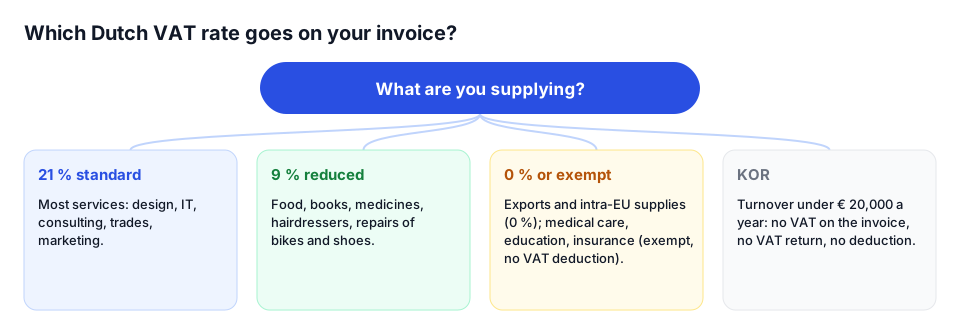
When do you charge 21%?
The Belastingdienst calls 21% the high or general rate. The rule is simple: if there is no reason to apply an exemption, the reverse-charge mechanism, the 0% rate or the 9% rate, you charge 21%. For most freelancers in the Netherlands, such as developers, designers, consultants, photographers and marketers working for Dutch clients, that is the rate on every invoice. You put the net amount, '21% VAT' and the VAT amount in euros on the invoice, collect the VAT from your client, and pay it to the Belastingdienst in your VAT return.
When does the 9% rate apply?
The 9% rate is called the low rate. It applies to a fixed list of goods and services, including food and drink, agricultural products, medicines, books, and newspapers and magazines. The complete list is only published in Dutch on the Belastingdienst website. If your service is not on that list, 9% is not an option, even if it feels like it should be. Freelancers who do run into the 9% rate are typically in food, publishing or certain repair trades; a copywriter, for example, charges 21% on the writing even when the client is a magazine that sells at 9%.
When is the rate 0%?
The 0% rate applies to entrepreneurs who do business abroad from the Netherlands: mainly supplies of goods to businesses in other EU countries, and some cross-border services such as the international transport of goods and international passenger transport. The important feature of 0% is that you still retain the right to deduct VAT on your costs. You show the supply on the invoice with '0% VAT' and €0.00 VAT. Do not confuse 0% with the reverse charge: when you supply a service to a business in another EU country, you normally reverse-charge the VAT rather than apply 0%, which is explained in reverse-charge VAT invoices for EU clients.
What does “exempt” mean for your invoice?
Some goods and services are exempt from VAT. The Belastingdienst lists, among others: letting or selling immovable property that is more than two years old, education, healthcare services, sports organisations and clubs, services by socio-cultural institutions, financial services and insurance, childcare, care services and home care, services by composers, writers and journalists, and fundraising activities. In case of an exemption you pay no VAT and you can deduct no VAT: you are not able to claim a refund of the VAT charged on costs and investments that relate to exempted goods and services. On an exempt invoice you charge no VAT and state why, for example 'VAT exempt: medical services'.
What is the KOR and when does it pay off?
The small business scheme (KOR) lets you stop charging VAT if your turnover is at most €20,000 per calendar year. Business.gov.nl describes the consequences: you do not charge your customers VAT, you cannot deduct VAT on business costs and investments, and you do not file VAT returns (apart from a one-off return in some cases). You apply through a Dutch-language form in Mijn Belastingdienst Zakelijk, at least 4 weeks before the start of the next return period. If your turnover goes over €20,000 you must notify the Belastingdienst right away and you become subject to VAT. Businesses with a turnover of no more than €2,200 that do not have to register with the KVK take part automatically.
The KOR is attractive if your clients are consumers or exempt organisations that cannot deduct VAT, because your price drops by 21% for them. It is less attractive if your clients are businesses, who deduct the VAT anyway, and if you have significant costs with VAT on them, because you lose that deduction. If you do send an invoice under the KOR, you do not show a VAT rate or amount; you state that you apply the small business scheme.
0%, exempt or KOR: what is the difference?
All three result in an invoice without VAT, which is why they get mixed up. The difference is in what happens to the VAT on your own costs. With 0% you keep the right to deduct it. With an exemption or the KOR you lose it. For your VAT return the difference matters too: 0% supplies are reported, exempt turnover is not taxed, and under the KOR you do not file at all. Writing '0%' on an invoice when you are actually exempt is a common mistake that can lead to questions during an audit.
Which rate applies to clients abroad?
For business clients in other EU countries you usually reverse-charge the VAT: no Dutch VAT on the invoice, your client accounts for it at home. For business clients outside the EU you usually do not charge Dutch VAT either, though the country where the service is used can decide to charge VAT. Services to private individuals abroad are normally subject to Dutch VAT. The details, including the invoice wording and the VIES check, are in the separate article on reverse charging.
How do you show the rate on the invoice?
Whatever rate applies, the invoice must show, per rate or exemption, the price excluding VAT, the VAT rate and the VAT amount in euros. An invoice that combines 21% and 9% items therefore has two subtotals and two VAT lines. If you invoice €1,000 of consultancy at 21% and €200 of books at 9%, you show €1,000.00 + €210.00 VAT and €200.00 + €18.00 VAT, total €1,428.00. If no VAT is charged, say why: '0% VAT', 'VAT exempt', 'VAT reverse-charged' or 'small business scheme (KOR) applied'.
Quick decision list
- You are in the KOR: no VAT, state that the KOR applies
- Your service is exempt (healthcare, education, insurance and so on): no VAT, state the exemption
- Business client in another EU country, service: VAT reverse-charged, show both VAT ids
- Business client in another EU country, goods: 0%, show both VAT ids
- Business client outside the EU: usually no Dutch VAT; for consumers, check the rules for your type of service
- Goods or services on the 9% list, Dutch client: 9%
- Everything else: 21%
In Factando's free invoice generator you pick 21%, 9%, 0%, the KOR exemption or reverse charge per invoice, and the required wording appears on the PDF automatically. Pro adds a VAT overview per quarter, split into the boxes of the Dutch VAT return; see pricing.
Sources
The rules in this article come from these official pages. Check the current amounts and deadlines there.
Frequently asked questions
What is the standard VAT rate in the Netherlands?
21%. It applies whenever there is no reason to use an exemption, the reverse-charge mechanism, the 0% rate or the 9% rate.
What is the difference between 0% VAT and VAT exempt?
With 0% you charge no VAT but keep the right to deduct VAT on your costs. With an exemption you charge no VAT and cannot deduct VAT on related costs either.
Who can use the small business scheme (KOR)?
Entrepreneurs with a turnover of at most €20,000 per calendar year. You then charge no VAT, deduct no VAT and file no VAT returns. Apply at least 4 weeks before the next return period starts.
Do I need to show the VAT amount in euros?
Yes. Per VAT rate the invoice must show the price excluding VAT, the rate and the VAT amount in euros, even if you invoice in another currency.
Done with invoicing by hand?
Factando makes a correct Dutch invoice for you: numbering, VAT and layout are handled automatically. Try it free without an account; saving and sending takes a free account (3 sent invoices a month). Pro, with automatic payment reminders, is free for 14 days.