Client not paying your invoice in the Netherlands? The steps, the costs you may charge, and the limits
11 November 2026 · 7 min read · checked and edited by Jarno van den Hove
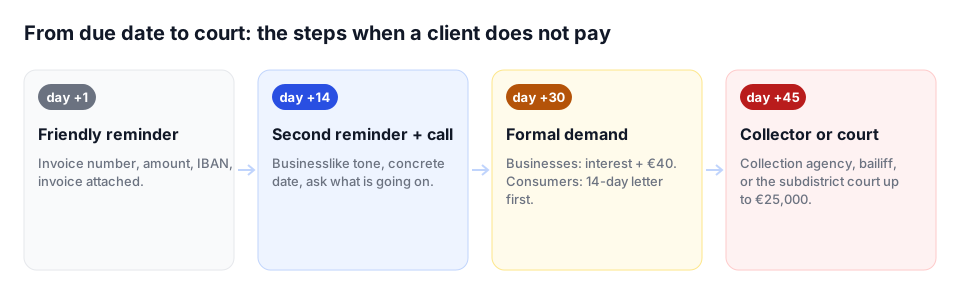
When a client does not pay, you follow a fixed path: a friendly reminder the day after the due date, a second one after a week or two, then a formal demand (for consumers the 14-day letter), and only then a debt collector or the subdistrict court. Most late payers pay at step one or two. This guide covers each step and what you are allowed to charge. (General information, not legal advice.)
Step 1: check your own side first
Before you chase, check that the invoice is correct and complete, was sent to the right address, and states a due date. A missing purchase order number or a wrong legal entity is the most common reason an invoice sits in a client's approval queue. If you have no written payment term, the statutory term of 30 days applies for business clients.
Step 2: when do you send the first reminder?
Right after the due date, send a short, friendly reminder with the invoice number, amount, due date and your IBAN in the email itself, and the invoice attached. Tone: “this probably slipped through”. The large majority of late payments are resolved here.
Step 3: second reminder and personal contact
Nothing after a week or two? Send a second reminder, more businesslike, with a concrete date by which you expect payment. Also just call. There is often a reason: a complaint about the work, cash-flow trouble, or an invoice stuck in a process. If your client cannot pay at once, agree a payment plan and confirm it by email.
Step 4: the formal demand (and the 14-day letter for consumers)
If the second reminder does not work, send a formal demand. With business clients you are already entitled, from the due date, to statutory commercial interest and a minimum of €40 compensation for collection costs; name both in the demand. With consumers you must first send a demand that gives the client 14 more days to pay without extra costs (the “14-day letter”). Only after that period may you charge collection costs according to the statutory scale.
Step 5: debt collector or bailiff
Still nothing after the demand? You can hand the claim to a collection agency or a bailiff (gerechtsdeurwaarder). They take over contact and charge the collection costs to your client. Ask in advance what it costs you if the client never pays, and whether they work on a no-cure-no-pay basis. A single letter from an agency is often enough.
Step 6: court
If payment still does not come, the subdistrict court (kantonrechter) can issue a judgment. For claims up to €25,000 you do not need a lawyer. With a judgment, a bailiff can seize assets, such as the client's bank account. Weigh the cost and time against the amount.
What may you charge on a €1,250 invoice?
A business client does not pay invoice 2026-0012 of €1,250.00; the due date was 1 September 2026. Collection costs follow the statutory scale (Wet incassokosten): 15% of the first €2,500, with a minimum of €40, so €187.50 here. Statutory commercial interest runs from the due date on top of that. For a consumer the same scale applies, but only after the 14-day letter, and the interest is the ordinary statutory rate (4% since 1 January 2026), which on €1,250 is under €10 per 60 days. The collection costs are what matters.
When does an unpaid invoice expire?
Unpaid invoices do expire. For business clients, and for services to consumers, the limitation period is 5 years after the payment term ended; for a product sold to a consumer it is 2 years. You extend the period (“stuiten”) by reminding in writing before it ends and stating that you continue to claim the amount. In practice you never wait that long, but do not let a forgotten 2024 invoice quietly lapse.
Can you reclaim the VAT if the client never pays?
Yes. You paid the VAT on the invoice in the quarter you sent it. If the claim turns out to be uncollectable, for example because of bankruptcy, you reclaim that VAT in your VAT return. How long you must wait before an invoice counts as uncollectable is set out on belastingdienst.nl; if the client pays later after all, you pay the VAT again. Do not mark the invoice as paid and do not issue a credit note if the work was delivered: that changes your turnover, not the fact that you were not paid.
What not to do
- Threatening in the first reminder: it costs goodwill and rarely speeds anything up.
- Charging collection costs to a consumer without the 14-day letter: they are not owed.
- Crediting the invoice to make the problem disappear: the debt is real, the credit note is not.
- Doing more work for a client who has not paid the previous invoice.
Prevention is cheaper
Agree the payment term in writing, send the invoice immediately after delivery, offer an easy way to pay (an iDEAL link or QR code), and remind on a fixed schedule. For larger jobs, ask for a deposit. Clients who pay late once tend to do it again; a shorter term or payment up front for the next job is reasonable.
How Factando helps
In Factando you see per invoice whether your client opened it and when, and every Monday you get an overview of what is open and what is overdue. Your client can confirm payment with one click on the invoice page. With Pro the first steps run themselves: a heads-up before the due date, a reminder the day after and optionally a second one later, in your own words. The second reminder names statutory interest and the €40 collection fee for business clients, and is a 14-day letter for consumers. Before every reminder you get an “already paid?” check, so you only step in when it is really needed.
Sources
The rules in this article come from these official pages. Check the current amounts and deadlines there.
Frequently asked questions
Can I charge interest from the due date?
With business clients, yes: statutory commercial interest runs automatically from the day after the due date. With consumers, ordinary statutory interest applies, and collection costs only after the 14-day letter.
How much are collection costs?
15% of the first €2,500 (minimum €40), 10% of the next €2,500, 5% of the next €5,000, and lower percentages above that, capped at €6,775.
Do I need a lawyer to go to court?
Not for claims up to €25,000: those go to the subdistrict court, where you may represent yourself.
Can I stop working for the client?
Yes, you may suspend further work until the overdue invoice is paid, as long as you say so clearly in writing.
Done with invoicing by hand?
Factando makes a correct Dutch invoice for you: numbering, VAT and layout are handled automatically. Try it free without an account; saving and sending takes a free account (3 sent invoices a month). Pro, with automatic payment reminders, is free for 14 days.