Invoice numbering in the Netherlands: the rules, and how to keep an unbroken series
11 November 2026 · 5 min read · checked and edited by Jarno van den Hove
Dutch invoice numbers must be unique and sequential, without gaps or duplicates (Article 35a of the Dutch VAT Act). You may use more than one series, as long as each series is unbroken on its own. You never delete a sent invoice; you correct it with a credit note. Gaps in your series are the first thing an auditor looks for. (General information, not tax advice.)
What are the rules for invoice numbers?
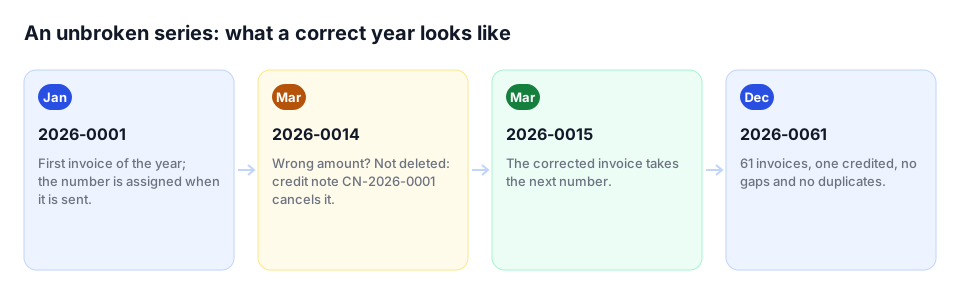
Each number appears once, and the series runs on without gaps. The format is up to you: 1, 2, 3 or 2026-0001, 2026-0002, as long as the order can be checked. Restarting every year with the year in the number is allowed and by far the easiest to keep tidy.
Do drafts count toward the numbering?
No. An invoice you have not sent yet is a draft and does not need a final number. The safest approach is to assign the number at the moment the invoice goes out. Then deleting a draft can never leave a hole in your series. Factando works this way: drafts are unnumbered until you send.
What do you do with a wrong invoice?
You do not delete a sent invoice with a mistake in it, because that creates a gap. Instead you issue a credit note: a document with negative amounts that cancels the old invoice and refers to it. Then you make a new, correct invoice with the next number. Your records stay complete.
How do you switch tools without breaking the series?
Moving from Word, Excel or another tool? Continue where you left off. If your last invoice was 2026-0023, the next one is 2026-0024, also in the new program. Starting again at 0001 halfway through the year produces duplicate numbers.
Are multiple series allowed?
Yes. The Belastingdienst allows “one or more series”, as long as each series is unbroken and each number is used once. A separate series for credit notes (CN-2026-0001) or for a second activity is fine. Keep it explainable: two series are easy to defend, six mixed together are not. Quotes are a different matter entirely: a quote is not an invoice, so quote numbers do not have to be sequential and may have gaps.
Numbers and dates run the same way
Not only the numbers must increase, the dates must too. Invoice 2026-0030 dated before 2026-0029 raises questions. Create invoices when you send them and do not backdate an invoice you make later. Keep the deadline in mind as well: you must issue an invoice by the 15th day of the month after the month of supply. Work done in November is invoiced by 15 December at the latest.
Five ways a gap still appears
- Numbering drafts, then deleting one
- Two tools or two people issuing invoices from the same series
- Deleting a sent invoice instead of crediting it
- Restarting the series in a new tool mid-year
- A test invoice that took a real number
What if there is a gap anyway?
A gap does not automatically mean a fine, but it does mean a question. Whoever can answer it immediately is done. So record what happened as soon as you notice: a short note such as “Number 2026-0031 not used: draft deleted on 14 March 2026” in your records is enough. Keep that note as long as your invoices, seven years. Do not try to fill the gap afterwards with a backdated invoice; that makes it worse. If the problem is a sent invoice with the wrong amount, issue a credit note.
Partial invoices and deposits
If you invoice a job in parts, each part gets its own number in the same series: the deposit, the interim invoice and the final invoice are three invoices. On the final invoice you refer to the earlier numbers and deduct what has already been paid. That keeps the total transparent for you, your client and the Belastingdienst.
Sources
The rules in this article come from these official pages. Check the current amounts and deadlines there.
Frequently asked questions
Can I start at 1 or at 1000?
Either. The starting point is free; what matters is that the series then continues without gaps.
Can I restart numbering each year?
Yes. 2026-0001 to 2026-0061 and then 2027-0001 is the most common format for Dutch freelancers.
Do credit notes need their own series?
They may have their own series or share the invoice series. Both are allowed; just be consistent.
How long do I keep invoices?
Seven years, ten years for invoices concerning real estate.
Done with invoicing by hand?
Factando makes a correct Dutch invoice for you: numbering, VAT and layout are handled automatically. Try it free without an account; saving and sending takes a free account (3 sent invoices a month). Pro, with automatic payment reminders, is free for 14 days.