Invoicing under the Dutch small business scheme (KOR): no VAT, but not no rules
11 November 2026 · 6 min read · checked and edited by Jarno van den Hove
Under the Dutch small business scheme (kleineondernemersregeling, KOR) you still send invoices, but without VAT: no rate, no VAT amount, and a line saying you are exempt under the KOR. Every other invoice requirement stays. The scheme is open to businesses with Dutch turnover of up to €20,000 per calendar year. This guide shows what the invoice looks like, how the threshold is counted, and what happens on the day you cross it. (General information, not tax advice.)
How does the KOR work?
You can join if your turnover in the Netherlands stays at or below €20,000 in a calendar year. You register with the Belastingdienst; once approved, you no longer charge VAT on your sales and no longer file VAT returns. The trade-off: you also cannot reclaim the VAT on your business costs, such as a laptop, software or your phone. If you cross the threshold during the year, the exemption ends immediately and you charge VAT from that moment on. The rules have changed a few times in recent years, so check the current conditions on belastingdienst.nl before you rely on them.
Do you still have to send invoices under the KOR?
Strictly, the KOR exempts you from the VAT invoicing obligation. In practice nearly every freelancer sends invoices anyway: business clients need one for their own books, and for you it is the proof of your turnover for income tax. Your KVK number belongs on it, because it has to appear on all your business correspondence.
What goes on a KOR invoice?
- Your name, address and KVK number (your VAT ID is optional: you have one, but you are not charging VAT)
- Your client's name and address
- A sequential invoice number and the invoice date
- What you delivered, with quantity and price
- One total, without a VAT line
- The exemption wording, for example: “Exempt from VAT under the small business scheme (KOR), Article 25 of the Dutch VAT Act 1968”
What is the one mistake to avoid?
Never put VAT on an invoice while you are in the KOR. VAT that appears on an invoice is in principle owed to the Belastingdienst, even if you are exempt. An old Word template with a fixed “21% VAT” line is exactly how this goes wrong. The reverse applies too: the day you leave the KOR or cross the threshold, VAT has to go back on every invoice from that day.
What does a €1,250 invoice look like under the KOR?
Say you are a copywriter and worked 25 hours in March at €50 an hour. Without the KOR the invoice reads €1,250.00 excluding VAT, €262.50 VAT (21%), total €1,512.50. Under the KOR the VAT line disappears: one amount, €1,250.00, with the exemption wording underneath. For a private client that is €262.50 cheaper; for a business client it makes no difference, because they would have reclaimed the VAT anyway. The downside shows up on your own purchases: buy a €1,210.00 laptop including VAT and the €210.00 VAT is simply a cost to you.
How do you count turnover for the €20,000 limit?
The limit is about your turnover per calendar year, excluding VAT, and applies both to the year you register and the year before. Not everything counts. Included: everything you supply in the Netherlands at 21%, 9% or 0%. Not included: services taxed in another country, such as work for a business client in Belgium where you reverse-charge the VAT. If you run several activities under one business, you add all turnover together; the KOR then applies to the whole business, not to one branch.
What happens on the day you cross the limit?
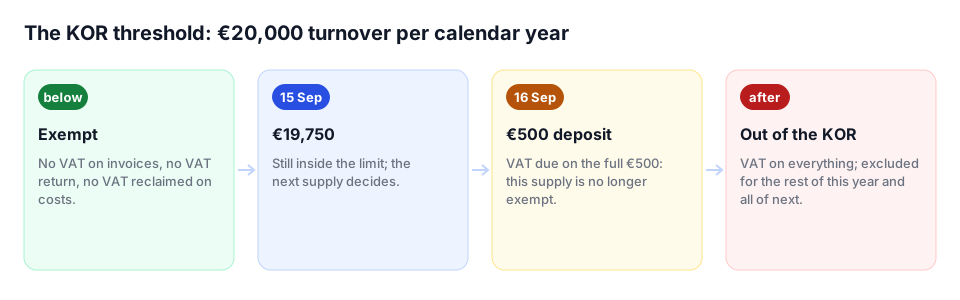
Cross the €20,000 during the year and the exemption ends at once, and the supply that takes you over the line is no longer exempt either. The Belastingdienst's own example: your turnover stands at €19,750 on 15 September and the next day you receive a €500 deposit. VAT is due on the full €500, and from 16 September you charge VAT on everything. You deregister immediately via Mijn Belastingdienst Zakelijk. After that you cannot simply go back: you are excluded from the KOR for the rest of that calendar year and the whole of the next. If you are at €18,000 in November with a big project coming, work out in advance whether you will cross the line and put the VAT in your quote already.
Can you leave the KOR voluntarily?
Yes. You deregister with the Belastingdienst, and the exemption ends at the start of the next VAT period after your notice. Leaving makes sense when your business costs are high (you want the VAT back) or when your clients are all businesses (they do not care about VAT, and you lose nothing by charging it). The same exclusion applies: after leaving, you cannot rejoin for the remainder of that year and the following year.
Four traps under the KOR
- Charging VAT by accident on one invoice: you owe it, and you have to correct it with a credit note.
- Counting the limit per 12 rolling months instead of per calendar year.
- Forgetting that reverse-charged EU work does not count toward the €20,000, so you are further below the limit than you think.
- Reclaiming VAT on costs: you cannot, so compare prices including VAT when you buy equipment.
How Factando handles the KOR
In Factando you choose the KOR option per invoice. The invoice gets the correct exemption wording, no VAT is calculated, and numbering continues with your other invoices. Quotes and recurring invoices can use the option too. If you later start charging VAT, you switch the option off and everything is correct again, without a new template.
Sources
The rules in this article come from these official pages. Check the current amounts and deadlines there.
Frequently asked questions
Do I need a VAT ID if I am in the KOR?
You receive one when you register your business, but you do not have to show it on invoices while you are exempt. Showing it is allowed.
Can I reclaim VAT on costs under the KOR?
No. That is the price of the exemption. If your costs are high, leaving the KOR may be better.
Does income from clients abroad count toward the €20,000?
Services taxed in another country, such as reverse-charged work for EU businesses, do not count. Supplies taxed in the Netherlands do.
What wording do I put on the invoice?
State that you are exempt from VAT under the small business scheme (KOR), Article 25 of the Dutch VAT Act 1968. Factando adds this line automatically.
Done with invoicing by hand?
Factando makes a correct Dutch invoice for you: numbering, VAT and layout are handled automatically. Try it free without an account; saving and sending takes a free account (3 sent invoices a month). Pro, with automatic payment reminders, is free for 14 days.