E-invoicing mandatory in the Netherlands from 2030: what changes for freelancers
16 November 2026 · 5 min read · checked and edited by Jarno van den Hove
From 1 July 2030 you must send a business in another EU country an e-invoice, within 10 days of your supply, and report the invoice data digitally to the Belastingdienst. That is fixed in EU rules. The Dutch cabinet wants to make e-invoicing mandatory on the same date for invoices to Dutch businesses too, with digital reporting from 1 July 2031. That bill still has to pass Parliament. If you use the small business scheme (KOR), you are exempt for domestic invoices under the plans. (General information, not tax or legal advice.)
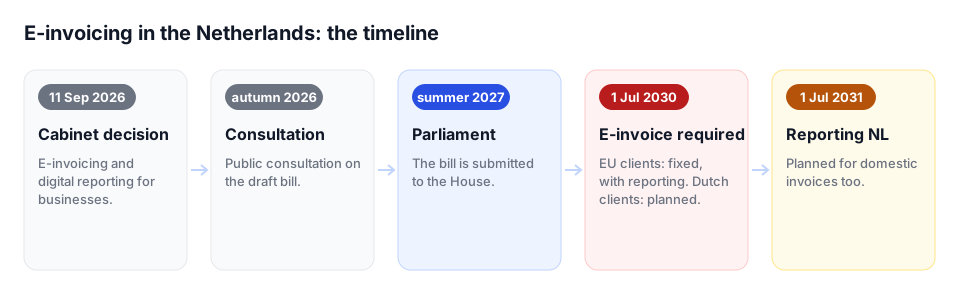
The timeline
- Now: you already send only e-invoices to the central government (Rijksoverheid). Other public bodies can ask their suppliers for them.
- 11 September 2026: the cabinet chooses e-invoicing and digital reporting for businesses.
- Autumn 2026: the draft bill goes into public consultation.
- Before summer 2027: the cabinet wants to submit the bill to the House of Representatives.
- 1 July 2030: e-invoice and digital reporting mandatory for invoices to businesses in other EU countries. Under the plans, also the e-invoice for invoices to Dutch businesses.
- 1 July 2031: under the plans, digital reporting of domestic invoices.
What is fixed and what is not?
The rules for invoices to businesses in other EU countries come from EU legislation (Directive (EU) 2025/516, part of ViDA); the Netherlands has to implement them. The Dutch rules for domestic invoices are not final: Ondernemersplein and the KVK call the 1 July 2030 date “expected” and “if the bill is passed”. How the digital reporting will work technically is still being studied by the cabinet.
Who does it apply to?
- You invoice businesses in other EU countries: mandatory from 1 July 2030, also as a freelancer
- You invoice Dutch businesses: under the plans, from 1 July 2030
- You use the KOR (turnover up to €20,000 per calendar year): according to the cabinet, exempt for domestic invoices, also after July 2030
- You only invoice consumers: the plans are about invoices between businesses
What changes in practice?
- A PDF by email no longer qualifies: the e-invoice must follow a fixed European standard, so software can read it
- To EU clients you send the e-invoice within 10 days of your supply or service
- The digital reporting per invoice replaces the EC Sales List (opgaaf ICP) for transactions with businesses in other EU countries
- Your invoice requirements stay the same: the same details must be on it, only the format changes
Worked example: three invoices in July 2030
You are a web developer and invoice three clients in July 2030.
- An agency in Antwerp: €3,000, VAT reverse-charged. Work delivered on 3 July 2030, so the e-invoice must go out by 13 July. The invoice data goes to the Belastingdienst through the digital reporting; you no longer file an EC Sales List for it.
- A company in Utrecht: €1,500 + €315 VAT = €1,815. If the bill passes, you send this one as an e-invoice too. Under the plans, reporting of domestic invoices only follows from 1 July 2031.
- A consumer in Zwolle: €400 + €84 VAT = €484. Not covered by the plans; a PDF by email remains possible here.
What you can arrange now
- Look at how you send and receive invoices now, and to whom: how many business clients, and how many in other EU countries?
- Ask your software provider what is already possible: making an e-invoice (UBL) and sending it via Peppol, and whether you can also receive e-invoices
- Make sure your client details are right: full company name, address, KVK number and VAT ID. An e-invoice is validated on those fields.
- Discuss with your accountant how they want to receive your invoices
- Invoicing Belgian businesses? Peppol has been mandatory there since 1 January 2026; see reverse charge for EU clients for the VAT side
- Don't wait until 2030: when everyone switches at the same time, software providers and accountants get swamped
E-invoicing in Factando
With Pro you download every invoice as a UBL file (Peppol BIS Billing 3.0). Sending directly over the Peppol network from Factando is coming soon. What Factando cannot do yet: receive e-invoices (Factando is a program for sales invoices) and the digital reporting to the Belastingdienst. How that reporting will work is not yet settled; once the rules are known, you will read here what Factando does with them.
Sources
The rules in this article come from these official pages. Check the current amounts and deadlines there.
Frequently asked questions
When does e-invoicing become mandatory in the Netherlands?
For invoices to businesses in other EU countries on 1 July 2030. The cabinet wants to make e-invoicing mandatory on that date for domestic invoices between businesses too; that bill still has to pass Parliament.
Does the e-invoicing obligation apply to freelancers?
Yes, if you invoice other businesses. If you use the KOR, you are exempt for domestic invoices under the plans.
Can I still send a PDF invoice after 2030?
Not as the main invoice to businesses: a PDF by email does not meet the European standard. The plans do not cover invoices to consumers.
Does the EC Sales List (opgaaf ICP) disappear?
Yes. For transactions with businesses in other EU countries, the digital reporting per invoice replaces the EC Sales List from 1 July 2030.
Done with invoicing by hand?
Factando makes a correct Dutch invoice for you: numbering, VAT and layout are handled automatically. Try it free without an account; saving and sending takes a free account (3 sent invoices a month). Pro, with automatic payment reminders, is free for 14 days.