Invoicing a client outside the EU from the Netherlands: no Dutch VAT, but do it right
11 November 2026 · 6 min read · checked and edited by Jarno van den Hove
For services to a business client outside the EU you charge no Dutch VAT: the service is taxed in your client's country. You state on the invoice that VAT is not due in the Netherlands, and the VAT on your own costs stays deductible. Private clients outside the EU follow different rules. (General information, not tax advice.)
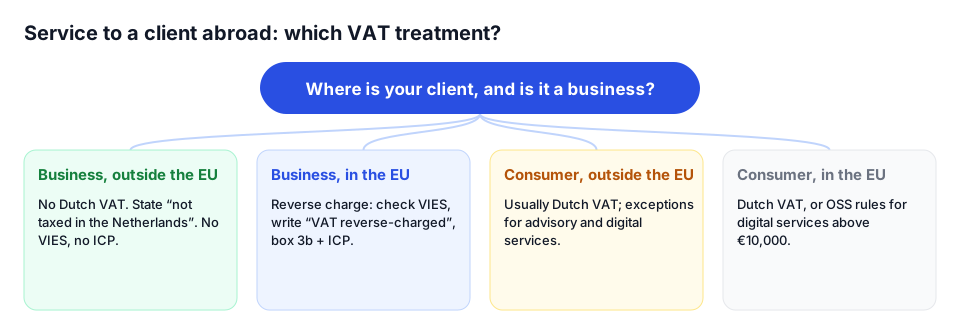
Business client outside the EU: no Dutch VAT
When you supply a service to a business outside the EU, the service is as a rule taxed where your client is, not in the Netherlands. So you charge no Dutch VAT; your client handles whatever applies locally. Make sure you can show the client is a business: a company registration, website, contract or an email address on the company's domain.
What do you write on the invoice?
- All the usual mandatory items: your details with KVK and VAT ID, client name and address, sequential number, dates, description
- The amount with no VAT line, or a VAT line of €0.00
- A statement that the service is not taxed in the Netherlands, for example: “VAT not applicable: place of supply outside the EU (Article 6 Dutch VAT Act)”
- Not the words “VAT reverse-charged”: that wording is for EU business clients only
Does it go in your VAT return?
Strictly, no: the Belastingdienst states that a service taxed outside the EU does not have to be reported in your VAT return. Many freelancers and bookkeepers still enter the turnover in box 1e (supplies taxed at 0% or not taxed with you), so that the VAT returns over the year match the annual turnover in the income tax return. Both approaches are common; pick one and be consistent. No EC Sales List (ICP) is needed: that is only for clients in other EU countries.
What about private clients outside the EU?
Consumers are different. For many services you simply charge Dutch VAT. For some, such as advisory and digital services, an exception applies and no Dutch VAT is due. If in doubt, check the specific service on belastingdienst.nl before you invoice.
And the United Kingdom?
Since Brexit the UK is no longer in the EU. A business client in London is treated as a client outside the EU: no Dutch VAT, no reverse charge, no VIES check, no ICP.
A €3,000 website for a client in New York
You build a website for a start-up in New York for €3,000. The invoice reads €3,000.00, VAT €0.00, total €3,000.00, with the note that the service is not taxed in the Netherlands. Had the client been a company in Utrecht, €630.00 VAT (21%) would have been added and the total would have been €3,630.00. The American client pays €3,000.00; any US tax is their matter. Invoicing in dollars is allowed, but convert the amount to euros for your own records and note the rate used.
What if the client turns out not to be a business?
If your client outside the EU turns out to be a private individual, you should have charged Dutch VAT, and that VAT is then inside the amount you received. Of the €3,000.00, €520.66 is VAT (€3,000.00 ÷ 1.21 = €2,479.34 net). You pay that over and keep €2,479.34. So ask for proof of business status before you send the invoice and keep it with the invoice. An email address on the company domain plus a signed contract is enough in practice.
Your input VAT stays deductible
Turnover taxed in your client's country counts as taxed turnover for the Belastingdienst. The VAT on your own costs, such as your laptop, software and phone, remains deductible in your VAT return. Buy a €1,210.00 laptop including VAT and you reclaim the €210.00 as usual, even if you only worked for clients outside the EU that quarter.
Checklist for your first invoice outside the EU
- Confirm the client is a business and keep the evidence
- Check whether the service is one where the place of supply is the client's country (most B2B services are)
- Invoice without VAT and with the “not taxed in the Netherlands” statement
- Decide whether you report it in box 1e, and do it the same way every quarter
- Keep reclaiming the VAT on your own costs
Goods are a different story
If you sell goods rather than services to a client outside the EU, that is export. You charge 0% VAT, report the turnover in box 3a of your VAT return, and must be able to prove the goods left the EU, for example with the customs declaration and transport documents. Without that proof the Belastingdienst can still assess 21% VAT.
How does this differ from an EU client?
For a business client in Germany or Belgium you use the reverse charge: check the VAT number in VIES, write “VAT reverse-charged” on the invoice, report the amount in box 3b and file an ICP declaration. For a client outside the EU all of that falls away: no VIES check, no ICP, only the statement that the service is taxed outside the Netherlands. Do not mix the two: “VAT reverse-charged” on an invoice to a US company is wrong. See reverse-charge VAT invoices for EU clients.
In Factando
Choose “0%: business client outside the EU” as the VAT option. The correct statement appears on the invoice, in English if the invoice is in English, and the VAT overview puts the amount in box 1e.
Sources
The rules in this article come from these official pages. Check the current amounts and deadlines there.
Frequently asked questions
Do I need my client's tax number?
No. Outside the EU there is no VIES check. You do need evidence that the client is a business.
Can I invoice in US dollars?
Yes. Convert the amount to euros for your records and note the exchange rate used.
Is Switzerland or Norway inside the EU for VAT?
No. Both are outside the EU for VAT purposes, so these rules apply, not the reverse charge.
What about digital services to consumers abroad?
Digital services to consumers are taxed where the consumer lives; outside the EU no Dutch VAT applies. Inside the EU the One Stop Shop (OSS) rules apply above €10,000 of such sales.
Done with invoicing by hand?
Factando makes a correct Dutch invoice for you: numbering, VAT and layout are handled automatically. Try it free without an account; saving and sending takes a free account (3 sent invoices a month). Pro, with automatic payment reminders, is free for 14 days.