Self-billing in the Netherlands: when your client issues the invoice on your behalf
16 November 2026 · 5 min read · checked and edited by Jarno van den Hove
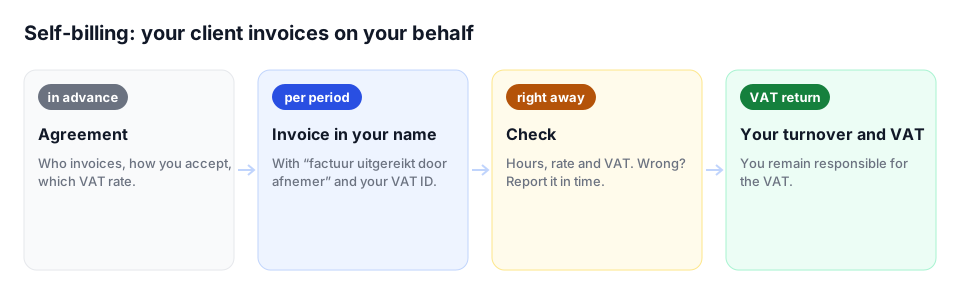
With self-billing it is not you who makes the invoice, but your client, in your name. You see it with some platforms, agencies and large clients. It is allowed if you agreed it in advance, if the invoice says “factuur uitgereikt door afnemer” (invoice issued by the customer) and if you check and accept every invoice. Even though your client makes the invoice, you remain responsible for its accuracy and for the VAT. (General information, not tax or legal advice.)
What the law says
- Article 35(2) of the Dutch VAT Act: your customer may draw up the invoice if you agreed this in advance, and if you accept each invoice through an agreed procedure
- Article 35a(1)(k): the invoice then carries the statement “factuur uitgereikt door afnemer”
- Article 34c: the invoice is issued in your name and on your behalf
- All other invoice requirements still apply: your name and address, your VAT ID, a sequential number, date, description, amount, VAT rate and VAT amount
What to agree in advance
The law does not require the agreement to be in writing, but without paper you cannot prove anything later. So put it in your contract or in the platform terms you accept:
- That your client draws up the invoices, and for which work
- How you check and accept each invoice, and within what period you object
- Which VAT rate and VAT treatment go on the invoices
- That your client hears in time when your VAT ID, address or business name changes, or when you join the KOR
What to check on every invoice
If something is wrong, report it in time. The invoice is then invalid and you issue an invoice yourself, unless you agree on a corrected version.
- The invoice is in your name, not your client's. According to the Belastingdienst, a credit invoice your client draws up in its own name is not correct.
- Your VAT ID and address are right
- The statement “factuur uitgereikt door afnemer” is on it
- The work, period, hours or quantities and rate match what you did
- The VAT rate is right for your work, and the VAT amount is calculated correctly
Numbering: whose series?
Your client must use sequential numbers for the invoices it makes on your behalf. You include each invoice as a sales invoice in your own records. According to the Belastingdienst you may keep your client's number or give it a sequential number of your own. Pick one method and stick to it. Do not also make an invoice yourself for the same work: the same turnover would then be in your records twice, with VAT twice.
You remain responsible for the VAT
Even though your client made the invoice, you as the supplier are liable for its accuracy and you pay the VAT to the Belastingdienst. Also if your client put too much VAT on the invoice. The VAT of a self-billed invoice simply goes into your VAT return, in the period of the invoice date. You keep a copy of every invoice, just like your own invoices (Article 35c).
Worked example: a platform's monthly invoice
You work through a platform that invoices on your behalf every month. For October 2026 the platform issues invoice SB-2026-1041 in your name on 3 November: 37 hours × €50 = €1,850, VAT 21% €388.50, total €2,238.50, with the statement “factuur uitgereikt door afnemer”. You check the hours and the VAT amount (21% of €1,850 is €388.50) and accept the invoice. Your return for the fourth quarter gets €1,850 turnover and €388.50 VAT in box 1a. If the platform had charged 9% when 21% is right, you report it and wait for a corrected invoice; otherwise you will later pay VAT you never received.
When to watch out
- You use the KOR: then there must be no VAT on the invoice. If there is VAT on it anyway, you owe it. See the small business scheme (KOR).
- You work for a client in another EU country and the VAT is reverse-charged: check that “btw verlegd” (reverse charge) and your client's VAT ID are on it. See reverse charge for EU clients.
- You only get a payment with a statement, not a copy of the invoice: ask for the invoice itself, because you need it for your records.
Self-billing and Factando
Factando makes invoices that you issue yourself. An invoice your client makes on your behalf cannot be entered in Factando as a sales invoice: such an invoice therefore does not count in Factando's VAT overview and annual overview. Add its turnover and VAT to your return yourself, or give the invoices to your accountant. If you also invoice other clients yourself next to the platform, your Factando numbering simply continues; the self-billed invoices keep your client's number or get a series of their own in your records.
Sources
The rules in this article come from these official pages. Check the current amounts and deadlines there.
Frequently asked questions
May my client make the invoice for me?
Yes, if you agreed this in advance, if you check and accept every invoice, and if it says “factuur uitgereikt door afnemer” (invoice issued by the customer).
Who is responsible for the VAT with self-billing?
You, as the supplier. You are liable for the accuracy of the invoice and pay the VAT on it, even if it is too high.
Which invoice number does a self-billed invoice get?
Your client uses a sequential number. You may keep that number or give it a sequential number of your own in your records.
What if the self-billed invoice is wrong?
Report it to your client in time. The invoice is then invalid and you issue an invoice yourself, unless you agree on a corrected invoice.
Done with invoicing by hand?
Factando makes a correct Dutch invoice for you: numbering, VAT and layout are handled automatically. Try it free without an account; saving and sending takes a free account (3 sent invoices a month). Pro, with automatic payment reminders, is free for 14 days.